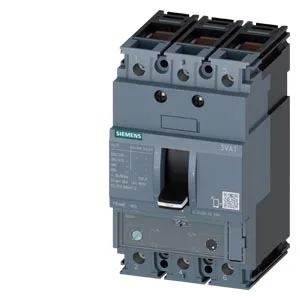
Its interrupting capacity hits 121 kA at 240 V and 75.6 kA at 415 V, so it handles high-fault service-entrance or distribution positions where the upstream transformer can dump serious energy into a bolted fault. The TM240 release means the thermal element is fixed-trip at 16 A (no field-adjustable thermal dial), and the magnetic pickup is set at 240 A — 15× the rated current.
The 16 A rating holds flat from 40 °C to 50 °C ambient; above that it derates to 15.36 A at 55 °C, 15.04 A at 60 °C, 14.72 A at 65 °C, and 14.4 A at 70 °C. Plan your load at 14 A continuous to stay clear of the thermal curve. Interrupting capacity drops as system voltage climbs: 121 kA at 240 V, 75.6 kA at 415 V, 52.5 kA at 440 V, and 11.9 kA at 690 V.
No trip indicator, no voltage trigger, no communication function, no phase failure detection, and no ground fault monitoring. It's a straightforward line-protection MCCB — not a multifunction power monitor. If you need remote trip indication or ground fault, you'd add an external module or specify a different variant.
The 76.2 mm width is three 25.4 mm pole spaces — standard for a 3-pole MCCB on a DIN rail or panel-mount footprint. Depth of 70 mm means it clears most shallow enclosures, but check the gland plate clearance if you're back-paneling with a cover. The electrical life will be lower depending on the load current and switching frequency; for frequent switching applications, factor in a replacement interval well before that number.