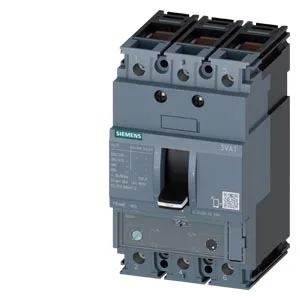
The 3VA1196-5EF36-0KC0: Interrupting capacity is the headline spec here: 187 kA at 240 V AC, 121 kA at 415 V, 75.6 kA at 440 V, and 17 kA at 500 V and 690 V.
Compared to the 3VA1110-5EE32-0LC0, which is a lower-frame 3VA1 variant with a 32 A frame and different interrupting ratings, the 3VA1196-5EF36-0KC0 uses the same 3VA1 platform and shares the same 70 mm depth and 76.2 mm width. The deciding factor between them is the required interrupting capacity at your system voltage — the 3VA1196-5EF36-0KC0 carries the higher 187 kA at 240 V, while the 3VA1110-5EE32-0LC0 is rated lower. If your panel was specified around the 3VA1110-5EE32-0LC0, check the interrupting duty before swapping; the physical footprint is the same, but the protection curve may differ.
Dimensions are 70 mm deep, 76.2 mm wide, 130 mm high — a standard 3-pole MCCB footprint that fits most DIN-rail or panel-mount enclosures. Rated insulation voltage is 800 V, and the operating temperature range is -25 °C to 70 °C, with storage from -40 °C to 80 °C. Maximum power loss is 10.6 W, which is modest for a 16 A breaker.