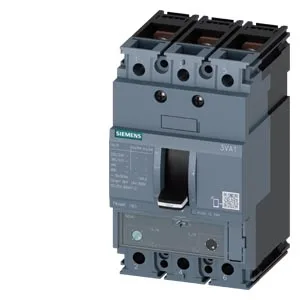
The Siemens SENTRON 3VA1196-6EF32-0BA0 is a 3-pole molded case circuit breaker (MCCB) rated 16 A continuous at 40 °C, with a short-circuit breaking capacity of 220 kA at 240 V AC. That SCCR figure drops to 154 kA at 415 V, 121 kA at 440 V, and holds at 17 kA through 500–690 V — meaning this breaker handles utility-grade fault levels on the low-voltage side without cascading upstream.
DIN-rail footprint and panel fill
The case measures 76.2 mm wide, 130 mm high, and 70 mm deep — a standard 3-pole MCCB footprint that clips onto a DIN rail or mounts with screws. At 70 mm depth, it clears most shallow gland plates and dead-front covers without forcing a deeper enclosure. The 16 A rating holds flat from 40 °C to 55 °C, then derates to 15 A at 60–70 °C — useful when the breaker sits near transformers or drives that raise cabinet ambient.
Undervoltage release — what it means in the panel
That's common in safety circuits where a loss of control power must open the main breaker — think emergency-stop chains or undervoltage protection on a machine feeder. The release is factory-fitted; no field kit to add. Max power loss is 13.1 W, which is typical for a 16 A MCCB with a UVR coil holding continuously.