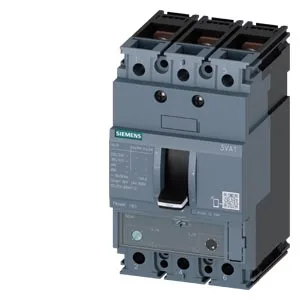
SENTRON 3VA1196-6EF32-0BH0 — 16 A MCCB with 220 kA SCCR at 240 V
The Siemens 3VA1196-6EF32-0BH0 is a SENTRON 3-pole molded case circuit breaker rated for 16 A continuous current (Iu) with a TM240 thermal-magnetic overcurrent release. Its interrupting capacity hits 220 kA at 240 V, 154 kA at 415 V, and 121 kA at 440 V — figures that place it in the high-fault-current class for industrial distribution. The 800 V rated insulation voltage (Ui) keeps it compatible with 480Y/277 V and 600 V delta systems. An undervoltage release (UVR) is integrated, and the auxiliary contact configuration is 2 auxiliary switches plus 1 trip alarm switch (HQ).
What the interrupting ratings mean for panel coordination
The 220 kA at 240 V is the SCCR the breaker can safely interrupt under fault — not its continuous rating. That number governs selectivity with upstream devices: a 220 kA-rated MCCB at the service entrance lets you coordinate downstream branch breakers with lower interrupting ratings, avoiding a cascade trip. At 415 V the 154 kA still covers most transformer secondary faults; at 690 V the 17 kA is adequate for motor-circuit protection but not for high-fault utility ties. The TM240 release is a fixed thermal-magnetic type — no electronic adjustment, so the trip curve is set at the factory for line protection (cable and busbar).
Derating and ambient temperature profile
The breaker carries its full 16 A rating from 40 °C through 50 °C. Above that it derates linearly: 15.36 A at 55 °C, 15.04 A at 60 °C, 14.72 A at 65 °C, and 14.4 A at 70 °C. The operating ambient range is -25 °C to 70 °C; storage range is -40 °C to 80 °C. If the panel ambient runs above 50 °C, size the continuous load against the derated value, not the nameplate 16 A.
Panel fit and mounting dimensions
The breaker measures 76.2 mm wide, 130 mm high, and 70 mm deep. The 3-pole footprint matches the standard SENTRON 3VA panel cutout. Front IP40 protection is sufficient for enclosed distribution boards but not for washdown environments. The undervoltage release (UVR) is wired separately — verify control voltage matches the coil rating before energizing.
