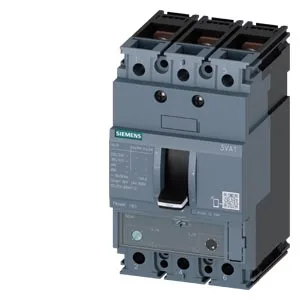
The Siemens SENTRON 3VA1196-6EF32-0CC0 is a 3-pole molded case circuit breaker (MCCB) rated 16 A continuous at 40 °C, with a massive 220 kA interrupting capacity at 240 VAC.
The 16 A rating holds steady from 40 °C up to 55 °C, then derates to 15 A at 60 °C and above — so in a warm panel you still get full current up to 55 °C, which is better than many breakers that start derating at 40 °C. The interrupting capacity drops as voltage rises: 220 kA at 240 V, 154 kA at 415 V, 121 kA at 440 V, and 17 kA at 500 V or 690 V. The auxiliary switches give you status feedback (open/closed) for PLC or indicator lights without needing an add-on module.
Where this MCCB fits in a panel
This is a DIN-rail-mount MCCB (70 mm deep, 76.2 mm wide, 130 mm tall), so it clips onto standard 35 mm DIN rail inside a distribution board or control panel. The 3-pole format handles three-phase circuits. Because it's a line-protection design, it's the right choice for the main incoming breaker or a branch feeder protecting cables and busbars — not for direct motor starting (that needs a motor-protective breaker with a different trip curve).