What the ratings mean for fit
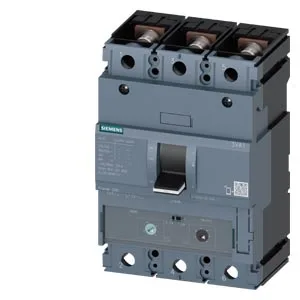
The 3VA1216-4EF32-0CA0 is a SENTRON molded case circuit breaker (MCCB) from Siemens, sized for line protection in distribution panels. Its 160 A continuous rating at 40 °C is the current it carries without tripping under normal conditions — that is the number to match against your load's full-load amps, not the breaker's frame size. The TM240 thermal-magnetic release provides fixed thermal and magnetic trip thresholds; no adjustment range, so verify the trip curve against your inrush and fault-clearing requirements before committing the BOM line. Breaking capacity tells you the maximum fault current the breaker can safely interrupt. At 240 V it is rated 121 kA, at 415 V 75.6 kA, at 440 V 52.5 kA, at 500 V 17 kA, and at 690 V 11.9 kA. For a 480 V panel the relevant figure is the 52.5 kA at 440 V — close enough to 480 V to use as a conservative guide. That is well above typical utility fault levels for most industrial services, so the breaker will hold coordination without cascading upstream. The 800 V rated insulation voltage confirms the internal clearances are designed for 690 V systems.
Thermal derating and operating range
The breaker holds its full 160 A rating from 40 °C through 50 °C (–). Above that it derates linearly: 156 A at 55 °C, 151 A at 60 °C, 147 A at 65 °C, 142 A at 70 °C. If the panel ambient runs hot — say next to a drive cabinet or in a non-conditioned enclosure — use the 70 °C figure (142 A) as your continuous limit. The operating temperature range is -25 °C to 70 °C (–), storage from -40 °C to 80 °C (–). Maximum power loss is 35.5 W, which matters for enclosure heat budget calculations.
Integration and mounting
The 3VA1216-4EF32-0CA0 measures 105 mm wide, 158 mm high, 70 mm deep (–). That is a standard 3-pole MCCB footprint for Siemens SENTRON — it fits the same panel cutouts and bus-bar spacing as other 3VA frame-size breakers. The undervoltage release (UVR) is built in, meaning the breaker will trip if control voltage drops below the release threshold — typical for emergency-stop or safety-related disconnection circuits. No communication function, no ground-fault monitoring, no voltage-trigger or trip indicator. It is a straightforward thermal-magnetic line-protection device.