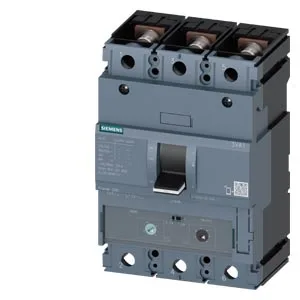
That TM240 designation means the thermal trip is fixed at 200 A and the magnetic short-circuit pickup is adjustable — so on a motor branch or a feeder, you set the magnetic threshold to ride through inrush without nuisance tripping, while the thermal element handles overloads. The breaking capacity at 240 V hits 121 kA, at 415 V it's 75.6 kA, at 440 V it drops to 25 kA, and at 690 V it's 11.9 kA — these are the SCCR values the panel builder uses for the upstream fault study. For a 200 A frame, that 121 kA at 240 V gives serious headroom on a low-voltage switchboard or a transformer secondary. The breaker carries a 2-auxiliary-switch plus 1-trip-alarm-switch HQ configuration, which means the panel gets both a status mirror and a dedicated alarm contact that closes only on a trip event — useful for a remote SCADA or a local beacon without extra interposing relays.
Thermal derating — the real-world current limit
At 55 °C it derates to 194 A, at 60 °C to 188 A, at 65 °C to 182 A, and at 70 °C to 176 A.
Dimensions are 105 mm wide, 158 mm high, 70 mm deep. That 105 mm width on a 3-pole 200 A frame is standard for SENTRON 3VA — it fits the same cutout and bus-bar spacing as other 3VA breakers in the 200 A class. The IP40 front protection means it's splash-proof from the front but not sealed; install it inside a panel with an IP54 or better enclosure if the environment is wet or dusty.