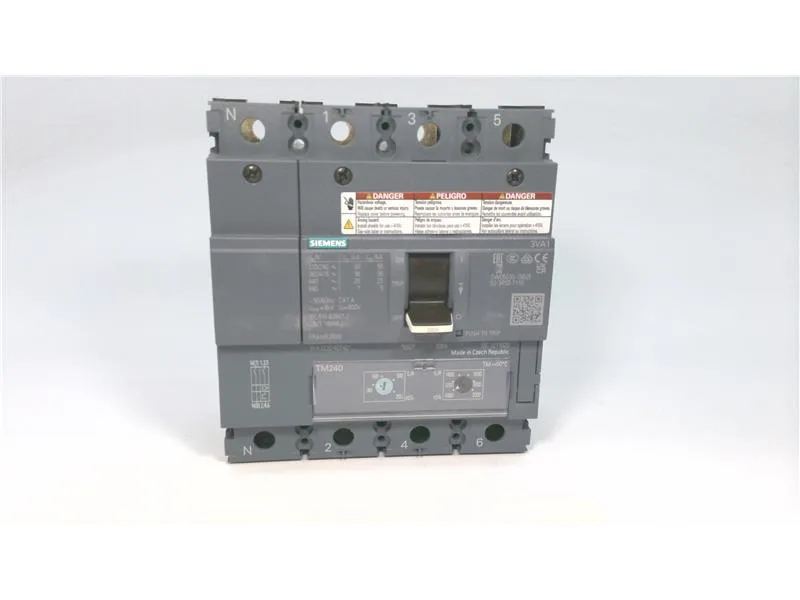
The TM240 trip unit gives you fixed thermal and magnetic settings; no adjustment dials, no electronic tweaks. What you set at the factory is what you get in the field. The interrupting ratings tell the real story. At 240 V it clears 121 kA; at 415 V it's 75.6 kA; at 440 V it drops to 52.5 kA; at 500 V it's 17 kA; at 690 V it's 11.9 kA. That's a lot of fault-current headroom for a 200 A frame — it means this breaker can sit upstream of a high-capacity transformer or a large bus without worrying about cascading failure. The continuous current holds at 200 A up to 50 °C, then derates to 194 A at 55 °C, 188 A at 60 °C, 182 A at 65 °C, and 176 A at 70 °C. If your panel runs hot, you lose about 12 % of capacity at the top end.
The 3VA1220-4EF42-0AA0 measures 70 mm deep, 140 mm wide, and 158 mm tall. If you're swapping out an older 3VA or a 3WL, check the depth: 70 mm is shallower than many legacy frames, so the gland plate and wiring gutters should have clearance. The width at 140 mm means it occupies 5.5 inches of DIN-rail or panel-mount space per pole.
What the TM240 trip unit means for your application
The TM240 designation means the thermal element is calibrated for a 200 A continuous rating and the magnetic (short-circuit) pickup is fixed at 10× In, so 2 000 A minimum and 1 000 A maximum for the magnetic trip band. It's a plain-vanilla line-protection breaker. If you need adjustable long-time or short-time pickup, you'd step up to an electronic trip unit like the ETU series. The 690 V interrupting rating of 11.9 kA is the limiting factor at that voltage — if your fault current exceeds that, you need a higher-rated frame or a current-limiting upstream device.