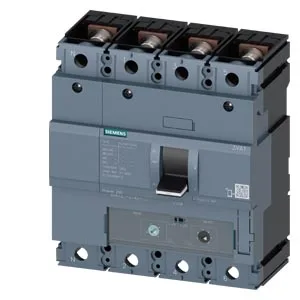
SENTRON 3VA1220-4EF42-0AF0 — 200 A MCCB with TM240 Release
The Siemens SENTRON 3VA1220-4EF42-0AF0 is a 4-pole molded case circuit breaker (MCCB) rated for 200 A continuous current at 40 °C, carrying the TM240 thermal-magnetic overcurrent release. Per the datasheet, the TM240 release provides fixed thermal and magnetic trip thresholds calibrated for line protection duty — no field adjustment on the trip curve, which simplifies specification but locks the coordination study to the factory setting. Breaking capacity is specified across five voltage levels: 121 kA at 240 VAC, 75.6 kA at 415 VAC, 52.5 kA at 440 VAC, 17 kA at 500 VAC, and 11.9 kA at 690 VAC. For a 200 A frame, the 121 kA at 240 V is the headline figure — it tells you this breaker can sit upstream of a 200 A bus without needing a current-limiting fuse for fault levels up to that threshold. The 11.9 kA at 690 V is the limiting case for 690 V lineups; verify your available fault current at the point of installation against that curve.
Current Derating and Thermal Management
The 200 A rating holds flat from 40 °C through 50 °C ambient. Above that, derating applies linearly: 194 A at 55 °C, 188 A at 60 °C, 182 A at 65 °C, and 176 A at 70 °C. If the panel ambient runs above 50 °C — common in non-ventilated enclosures or adjacent to heat sources — the continuous current must be reduced per this curve. The maximum power loss is 42 W at rated load; that figure drives enclosure ventilation sizing, not the breaker's own thermal limit. Rated insulation voltage is 800 V, which covers 690 V line-to-line systems with margin. The operating temperature range is -25 °C to 70 °C; storage range is -40 °C to 80 °C. The storage limit governs handling and warehousing, not running conditions.
Auxiliary and Alarm Switching
This unit ships with one auxiliary switch and one trip alarm switch (HQ type) factory-installed. The auxiliary switch signals the open/closed state of the main contacts; the trip alarm switch closes only on a fault trip (overcurrent or short-circuit), not on manual opening. For remote status monitoring or PLC-based fault annunciation, these contacts provide the dry-contact feedback without requiring an external shunt trip or undervoltage release — neither is present on this variant. No communication function or ground-fault monitoring is integrated. If you need Modbus, PROFIBUS, or ground-fault alarm, this is the wrong variant — look at the 3VA1 with communication module option or the 3VA2 series with electronic release.
