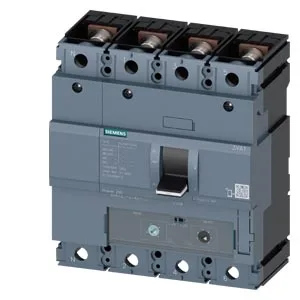
That 200 A rating holds flat from 40 °C through 50 °C, then derates to 194 A at 55 °C, 188 A at 60 °C, 182 A at 65 °C, and 176 A at 70 °C (–) — so in a warm panel you lose about 12% capacity at the top of the operating range. Breaking capacity is where this frame earns its keep: 121 kA at 240 V, 75.6 kA at 415 V, 25 kA at 440 V, and 11.9 kA at 690 V (–). That is a serious interrupting rating for a 200 A frame — it clears high-fault conditions without cascading upstream, which matters when you are coordinating selectivity in a main or feeder position. Front protection is IP40. The trip unit is TM240, a thermal-magnetic type. That means it is a straightforward, no-electronics overcurrent protector: thermal element for overload, magnetic element for short-circuit. It does not have a voltage trip or a shunt trip built in. For a panel where you just need a reliable main or feeder breaker with high interrupting capacity and no auxiliary electronics, this fits. The 4-pole design handles three-phase plus neutral, or can be used in DC networks per the 3VA device manual.
Dimensions: 158 mm height, 140 mm width, 70 mm depth. Width at 140 mm is standard for this current class; check the back-panel cutout or DIN-rail adapter if you are retrofitting into an existing footprint.