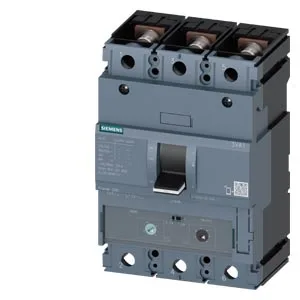
What this 3VA1220-5EF32-0KC0 delivers in the panel
Breaking capacity drops with system voltage as expected: 187 kA at 240 V, 121 kA at 415 V, 75.6 kA at 440 V, 30 kA at 500 V, and 17 kA at 690 V. At 415 V — common in European industrial grids — the 121 kA figure gives selectivity headroom against most downstream MCCBs and fuses. For a 690 V wind turbine nacelle auxiliary panel, the 17 kA rating still covers typical fault levels on the low-voltage side of the turbine transformer.
Thermal derating — no surprises up to 70 °C
Current rating holds flat at 200 A from 40 °C through 50 °C, then derates linearly: 194 A at 55 °C, 188 A at 60 °C, 182 A at 65 °C, and 176 A at 70 °C. In a sealed enclosure near a drive or transformer, the 176 A floor at 70 °C still leaves margin for a 175 A continuous load.
The 70 mm depth leaves room behind a 200 mm deep enclosure door for wiring gutters. The shunt trip (STL) and two auxiliary switches are factory-fitted; no field retrofit of those accessories is needed.