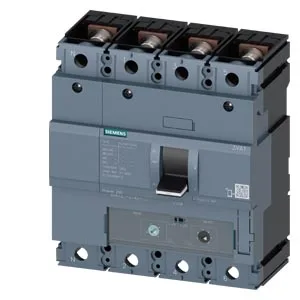
That 200 A holds flat from 40 °C up to 50 °C, then derates stepwise to 176 A at 70 °C — so if your panel runs hot near a drive bank or transformer, you still get the full rating up to 50 °C without having to oversize the frame. At 240 V it interrupts 187 kA; at 415 V it's still 121 kA; at 440 V it drops to 36 kA; and at 690 V it holds 17 kA. For a 200 A frame those are high-interrupt ratings — it's built for installations with high available fault current, like a main feeder in an industrial switchboard or a large motor control center.
What the TM240 release and undervoltage release mean for your panel
It's a fixed-trip design — no interchangeable rating plugs, so the 200 A frame is what you get. That's typical for a distribution feeder where the load is known and stable, not for a motor branch that needs adjustable overloads. This breaker includes an undervoltage release (UVR) — part number 3VA9608-0BB24 for the integrated auxiliary trip. That's common on safety circuits or emergency-stop chains where you want the breaker to open on loss of control power. It also means you need to verify the coil voltage matches your control circuit before wiring. If you need remote status feedback or ground-fault protection, you'd step up to a different order code in the 3VA family.
Physical fit: dimensions and panel integration
That depth includes the body only — add clearance for the handle throw and cable bending radius. The width is the critical dimension for multi-breaker lineups; at 140 mm per pole set, a 4-pole unit occupies the same width as two 2-pole units ganged together.