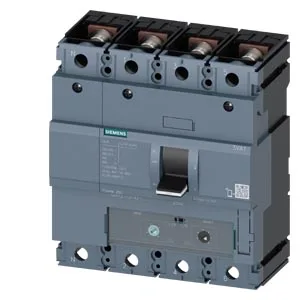
What this MCCB is and what it does
The Siemens SENTRON 3VA1220-5GF42-0DA0 is a 4-pole molded case circuit breaker (MCCB) rated at 200 A continuous, designed for line protection in distribution panels. It carries a TM240 thermal-magnetic overcurrent release — the thermal element handles overloads, the magnetic element clears short circuits — and includes an undervoltage release (UVR) as the auxiliary release type, so it can be tripped remotely when control voltage drops below a threshold.
Breaking capacity — what the numbers mean for your fault level
This MCCB's interrupting rating varies sharply with system voltage: 187 kA at 240 V, 121 kA at 415 V, 75.6 kA at 440 V, 30 kA at 500 V, and 17 kA at 690 V. At 415 V — common in European industrial distribution — the 121 kA figure covers most high-fault installations without needing a current-limiting upstream device. At 690 V the 17 kA rating is still adequate for many motor-control centers, but verify against the transformer's short-circuit capacity before specifying.
Thermal derating and panel integration
The 200 A rating holds flat from 40 °C through 50 °C ambient; above that it derates to 194 A at 55 °C, 188 A at 60 °C, 182 A at 65 °C, and 176 A at 70 °C. If the breaker is enclosed in a non-ventilated panel or stacked tightly with other heat sources, use the 60 °C or 65 °C column for your continuous-current budget. The 44.5 W maximum power loss at full load also needs to be dissipated — allow natural convection or forced airflow in the enclosure design.
Physical fit and mounting
Dimensions are 158 mm high, 140 mm wide, 70 mm deep — a 4-pole MCCB that fits standard Siemens SENTRON mounting bases and busbar systems. The 70 mm depth is shallow enough for most 200 mm deep enclosures; the 140 mm width means it occupies two 70 mm module spaces on a DIN rail or bolted busbar assembly. No trip indicator is fitted, so fault diagnostics rely on the undervoltage release status or an external indication circuit.
