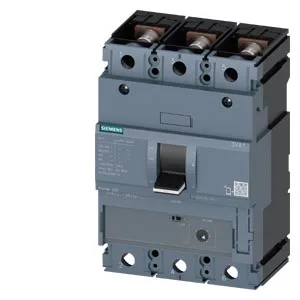
Siemens 3VA1220-5MH32-0AF0 — SENTRON MCCB, 200 A, Starter Protection
The Siemens 3VA1220-5MH32-0AF0 is a SENTRON molded case circuit breaker (MCCB) designed for starter protection, rated at 200 A continuous with a 3-pole configuration and a TM120M thermal-magnetic release. This is the part you spec when you need a 200 A frame that holds its rating from 40 °C all the way to 50 °C without derating — at 55 °C it still carries 194 A, and at 70 °C it delivers 176 A, so the thermal curve is flat enough for most panel environments without oversizing. The interrupting capacity is what you need to check against your available fault current: 187 kA at 240 V, 121 kA at 415 V, 75.6 kA at 440 V, 30 kA at 500 V, and 4.5 kA at 690 V. That 4.5 kA at 690 V is the weak point — if your system runs at 690 V with high fault current, this breaker needs upstream coordination. The rated insulation voltage is 800 V, so the frame itself is built for higher-voltage systems, but the breaking capacity at that voltage is limited. The auxiliary switch configuration is 1 auxiliary switch plus 1 trip alarm switch (HQ type), giving you one NO/NC for status feedback and one dedicated alarm contact that changes state only on a trip event — useful for remote fault indication without extra wiring. No undervoltage release, no ground-fault monitoring, no communication function on this variant; it's a straight thermal-magnetic breaker with basic aux contacts.
Integration — Panel Fit and Thermal Management
Dimensions are 70 mm depth, 105 mm width, 158 mm height — a standard 3-pole MCCB footprint that fits most DIN-rail or panel-mount enclosures. The 42 W maximum power loss at full load means you need to account for heat dissipation in a sealed enclosure; at 200 A continuous, that's real heat that will raise internal cabinet temperature, so factor it into your thermal calculation rather than assuming it's negligible. Operating temperature range is -25 °C to 70 °C, storage from -40 °C to 80 °C. The trip indicator is present, so you get a visual flag on a fault without needing to meter the load side. The design is explicitly for starter protection — meaning it's coordinated for motor-starting inrush and overload profiles, not just distribution feeder duty.
