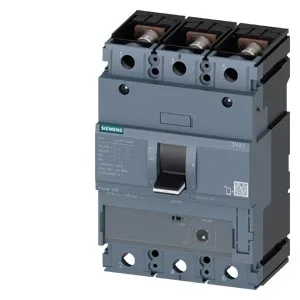
The Siemens SENTRON 3VA1220-5MH32-0JH0 is a 3-pole molded case circuit breaker (MCCB) rated for 200 A continuous current at up to 50 °C ambient — the full 200 A holds through 50 °C, then derates to 192 A at 55 °C, 188 A at 60 °C, 184 A at 65 °C, and 180 A at 70 °C, so in a hot panel you size against the derated figure, not the nameplate. The interrupting ratings are 187 kA at 240 V, 121 kA at 415 V, 30 kA at 440 V, and 17 kA at 690 V — these are the maximum fault currents the breaker can safely clear at those voltages, so for a 415 V supply you need the available fault current at the panel to be at or below 121 kA.
Panel integration and physical fit
Dimensions are 105 mm wide, 158 mm high, and 70 mm deep — the 105 mm width is the standard 3-pole MCCB footprint for this SENTRON frame, so it fits existing panel cutouts and busbar spacing designed for the 3VA family.
Auxiliary and trip options
The integrated auxiliary trip order code is 3VA9688-0BL32 — a factory-fitted accessory that should match the BOM if a replacement is needed. No undervoltage release, no communication function, no phase failure detection, and no ground fault monitoring are included — this is a straightforward thermal-magnetic breaker without electronic trip unit or network connectivity.