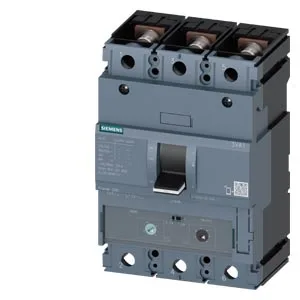
Its interrupting capacity reaches 220 kA at 240 V AC, 154 kA at 415 V, 36 kA at 440 V, and 17 kA at 690 V — figures that place it in the high-breaking-capacity tier for industrial main feeders and large sub-distribution boards. Current derating is flat at 200 A from 40 °C through 50 °C ambient, then steps down to 194 A at 55 °C, 188 A at 60 °C, 182 A at 65 °C, and 176 A at 70 °C. For a panel that runs warm — say, a packed MCC lineup at 55 °C — the effective rating is still 194 A, so a 200 A bus or downstream conductor needs to account for that 6 A gap. That UVR means the breaker drops out if control voltage falls below the dropout threshold — common in emergency-stop chains or mains-monitoring schemes where you want the main breaker to open on loss of control power.
Dimensions are 105 mm wide, 158 mm tall, and 70 mm deep — a standard 3-pole MCCB footprint that fits most 600 V switchboard chassis and DIN-rail adapters. Mount it in a dead-front enclosure or a motor control center bucket. If the application requires daily load switching, consider a contactor in series; the MCCB is designed for protection, not repetitive on-off duty.