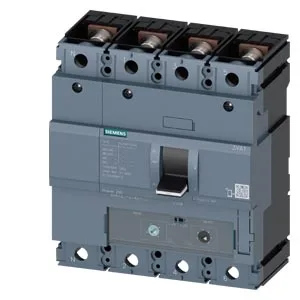
Its TM240 thermal-magnetic release handles overloads and short circuits without external trip units — a fixed-setting breaker, not an electronic one, so what you see on the dial is what you get. The interrupting ratings are substantial: 220 kA at 240 V, 154 kA at 415 V, 36 kA at 440 V, and 17 kA at 690 V, which means it can sit upstream of smaller breakers in a high-fault-current installation without needing a current-limiting reactor upstream.
The 200 A rating holds flat from 40 °C to 50 °C, then derates to 194 A at 55 °C, 188 A at 60 °C, 182 A at 65 °C, and 176 A at 70 °C. Plan the load accordingly; don't assume the nameplate 200 A is available at your actual ambient. The 220 kA at 240 V is the headline number, but the 154 kA at 415 V is what matters for most European and Asian 400 V-class distribution. That's enough to coordinate with a transformer secondary rated 150 kA or less without an upstream current-limiting fuse. At 690 V the 17 kA still covers most industrial motor-control centers.
Built-in undervoltage release
No voltage trigger or shunt trip on this variant; the UVR is the only release type fitted.
Physical fit
That 140 mm width across four poles is standard for a 200 A frame — it occupies the same footprint as other 3VA1 breakers in the same current class.