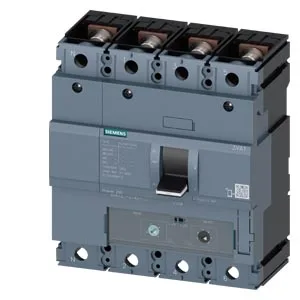
It's rated 200 A continuously at 40 °C, and holds that rating flat through 50 °C — at 55 °C it derates to 194 A, and at 70 °C it's still good for 176 A. That's a solid thermal curve for a panel that runs warm. The breaking capacity is the headline: 220 kA at 240 V, 154 kA at 415 V, 75.6 kA at 440 V, 30 kA at 500 V, and 17 kA at 690 V. That's a high-interrupting rating — it'll clear a fault upstream of a big transformer or a bus tie without the arc flash energy getting away from you. The 4-pole construction means it switches the neutral as well as the three phases, which is standard for TN-S or IT systems where you need full isolation. That's a common spec for emergency-stop chains or undervoltage protection on motor feeders. The basic switch assembly is order code 3VA12206EF420AA0.
Footprint is 140 mm wide by 158 mm tall by 70 mm deep — that's a 4-pole frame in a standard SENTRON 3VA form factor. The TM240 release is fixed thermal-magnetic — no interchangeable trip units on this variant, so the trip curve is set at the factory.