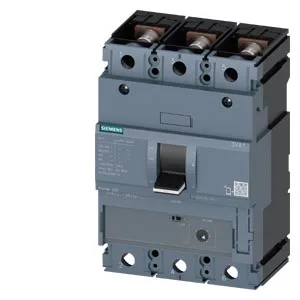
Rated continuous current Iu is 200 A, and it holds that rating flat from 40 °C through 50 °C ambient; above that it derates to 192 A at 55 °C, 188 A at 60 °C, 184 A at 65 °C, and 180 A at 70 °C — so in a warm panel you lose about 10 % at the top end. Breaking capacity is the headline number that decides whether this breaker survives a fault: 220 kA at 240 V, 154 kA at 415 V, 36 kA at 440 V, and 17 kA at 690 V — that 36 kA at 440 V is the figure most panel builders will check against their transformer or utility fault level.
The TM120M overcurrent release is a fixed thermal-magnetic trip — no interchangeable trip units, no electronic adjustment. That means the 200 A frame is the only setting; if your motor FLA is 180 A, this breaker works, but if you need adjustable overloads you want a different 3VA variant with an electronic release. The built-in undervoltage release (UVR) drops the breaker if control voltage disappears — common on safety circuits or E-stop chains. The 75 W operating power at AC-3 / 400 V is the motor-switching capability — that's roughly a 90 kW motor at 400 V, but always check the actual motor FLC against the 200 A continuous rating.
Dimensions: 105 mm wide, 158 mm high, 70 mm deep — a standard 3-pole MCCB footprint for a 200 A frame. The IP40 protection on the front means it's fine in a clean indoor panel; keep it out of washdown zones. Latching endurance is rated at 15 000 operations — that's the mechanical life for the switching mechanism, not the electrical endurance under load. For frequent switching applications, check the electrical life curve in the full datasheet.