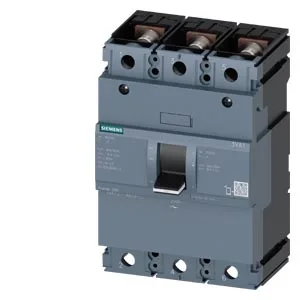
What this 3VA1 switch disconnector is — and isn't
The Siemens 3VA1225-1AA32-0AH0 is a SENTRON 3VA1 switch disconnector in MCCB-style housing, rated 250 A continuous at 40 °C through 50 °C without derating. It is a pure disconnecting means — no overload release, no short-circuit protection, no undervoltage release, and no communication function. What it does give you is a manually operated, three-pole load-break switch rated 690 V AC / 500 V DC, with a front-facing busbar connection and a built-in trip indicator. The thermal curve holds flat at 250 A up to 50 °C, then steps down: 243 A at 55 °C, 237 A at 60 °C, 230 A at 65 °C, 223 A at 70 °C.
The front-terminal busbar connection means the main power lands on the face, not the back — plan your busbar routing accordingly. IP40 on the front keeps out tools and fingers but not hose-down; keep this inside a sealed enclosure if washdown is nearby. Three CO auxiliary contacts (2 auxiliary switches HQ + 1 trip alarm switch HQ) are built in. The trip alarm switch changes state when the disconnector trips, so a PLC or annunciator can flag the open condition without a separate sensing circuit. Mechanical life is 15 000 operating cycles — adequate for a manual disconnect that sees a few operations per shift, not for a high-cycle motor-starting duty.
For a BOM-line commitment, the fit is confirmed by the 250 A continuous rating (flat to 50 °C), the 690 V AC / 500 V DC operating voltage, and the 3-pole front-busbar connection.