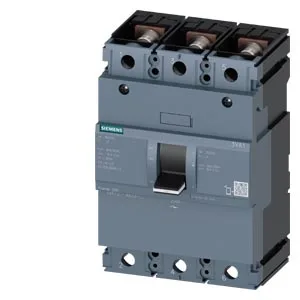
It is a pure disconnecting means — no overload or short-circuit protection — designed for applications where you need a manually operated, lockable disconnect with an undervoltage release (UVR) for safety or emergency-off circuits. The UVR is factory-fitted for 208-230 V AC 50/60 Hz, so if your control voltage matches, you avoid adding a separate shunt-trip module.
Rated continuous current Iu of 250 A is the maximum uninterrupted current the disconnector can carry without exceeding temperature limits. That matches a 250 A bus or feeder tap. Maximum operational voltage is 690 V AC 50/60 Hz and 500 V DC — so it works on 480 V or 600 V AC systems and on DC bus applications up to 500 V. The short-time withstand ratings (3 kA for 1 s and 3 kA for 0.5 s) tell you the disconnector can survive a fault current of that magnitude for that duration, but it is not a circuit breaker — it relies on upstream protection to clear the fault. The latching endurance of 15 000 operations is the mechanical life before the latching mechanism wears out — a solid figure for a switch disconnector in a panel that sees daily switching.
The 3VA1225-1AA32-0DA0 mounts in a standard panel cutout for SENTRON 3VA frame-size 250 MCCBs. Main circuit connection is busbar connection via front terminals — plan for busbar stabs or lug adapters; no screw terminals on the line side. The undervoltage release wiring is brought out separately; verify polarity if DC, though the UVR is AC-rated at 208-230 V. No auxiliary contacts are included (0 CO contacts), so if you need status feedback, order a separate auxiliary switch block.