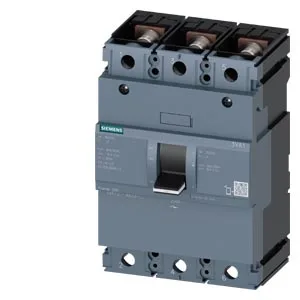
What this 3VA1 frame 250 switch disconnector is — and isn't
The Siemens SENTRON 3VA1225-1AA32-0KH0 is a 3-pole switch disconnector in an MCCB-style housing, rated 250 A continuously at 40 °C through 50 °C without derating — it holds full current right up to that ambient. Above 50 °C the thermal curve steps down: 243 A at 55 °C, 237 A at 60 °C, 230 A at 65 °C, 223 A at 70 °C. That's a clean, published derating ladder you can build into your panel thermal budget. Critical distinction: this is a switch disconnector, not a molded case circuit breaker. It has no overload or short-circuit protection — no trip curve, no magnetic or thermal-magnetic element. It's a load-break disconnect rated for isolation, intended to be paired with upstream protection (fuses or an MCCB). The shunt trip (STL) coil accepts 220-250 V DC or 208-277 V AC, giving you remote trip capability for emergency-off or process interlock circuits. The auxiliary contact block carries 2 HQ auxiliary switches plus 1 HQ trip alarm switch — that's three CO contacts total. The trip alarm signals when the disconnect has opened, whether by manual handle or shunt trip, so a PLC or safety relay gets a positive feedback wire.
Panel fit and connection
Footprint is 105 mm wide × 158 mm high × 70 mm deep — the 105 mm width is three 35 mm DIN modules side by side, so it occupies the same panel real estate as a 3-pole MCCB in the same frame. Front terminals accept busbar connection for the main circuit; the busbar kit with nut keepers is included (the 'nut keeper kit' in the description). The IP40 front face keeps finger-safe touch protection in a clean indoor panel. For a 250 A disconnect running continuously, factor that into your thermal calculation; it's roughly equivalent to a 60 W incandescent lamp running inside the panel. The 70 mm depth is shallower than the 86 mm of the 3VA2 frame peer — that 16 mm difference can matter in a tight backpanel or gland-plate clearance.
The 3VA1 frame 250 is the disconnect-only variant of the 3VA2 frame 250 MCCB. If your BOM originally called for a 3VA2225-5JQ32-0AK0 (an MCCB with ETU560 electronic trip unit, communication function, and LSIG protection), this 3VA1225-1AA32-0KH0 will not drop in as a direct replacement — it lacks the overcurrent protection and communication entirely. But the footprint and terminal arrangement are similar enough that a panel designed for the 3VA2 frame can often accept the 3VA1 disconnect with a busbar kit change and a different depth allowance (70 mm vs 86 mm). Verify the protection scheme upstream before swapping.
That 800 V Ui means the internal clearances and creepage are designed for 800 V systems — it's not just a 690 V part with a higher label. Mechanical service life is 15 000 operating cycles typical. That's a disconnect, not a contactor — it's not meant for frequent switching. For a line disconnect operated a few times per shift, that life is fine. If you need daily cycling under load, look at a contactor or a motor-rated switch instead. The shunt trip (STL) is a separate auxiliary release — not an undervoltage release. It trips on application of voltage, not on loss of voltage. If your safety circuit requires a drop-out on power loss, you need an undervoltage release (UVR), which this unit does not carry (listed as 'Undervoltage Release: No'). The STL is for remote pushbutton or PLC-initiated trip only.