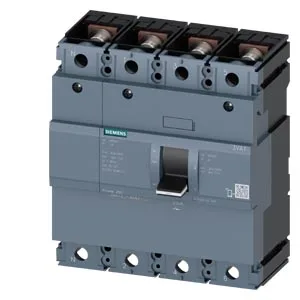
The front terminal accepts busbar connection, typical for panel main-switch or distribution positions. The trip indicator flags a mechanical fault, though there's no undervoltage release or communication module onboard.
Width 140 mm, height 158 mm, depth 70 mm — that's a standard 3VA1 frame footprint. The busbar connection on the front terminal means the busbars run across the front face; plan your gland plate and wireway clearance accordingly.
What it is not — and why that matters
This is a switch disconnector, not a circuit breaker. It has no overload protection (no thermal/magnetic trip) and no short-circuit protection — the 3 kA limited-time ratings (1 s and 0.5 s) are short-time withstand, not breaking capacity. It isolates a load under no-fault conditions only. If your BOM needs overcurrent protection, you need a separate MCCB or fuse upstream.
Ambient and storage limits
The 70 °C upper operating limit is above typical panel ambient, but derate for continuous full-load current at the high end per Siemens thermal curves. Latching endurance is 15,000 operations — adequate for a main disconnect cycled a few times per shift, not for a high-frequency switching role.