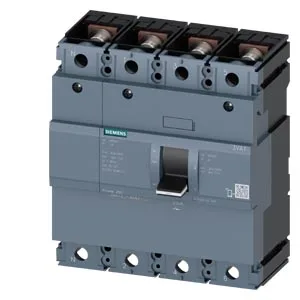
It is not a circuit breaker — it carries no overload or short-circuit protection elements. Its job is load-break isolation: safe manual switching under load, with visible contact position, for maintenance or emergency disconnection. Rated insulation voltage Ui is 800 V, with maximum operational voltage 690 V AC (50/60 Hz) and 600 V DC. That DC rating is notable — many switch disconnectors in this frame size top out lower. If your circuit runs DC bus voltages up to 600 V, this part stays within its rated envelope.
The Undervoltage Release — Critical for Safety Chains
In a safety circuit, the UVR coil drops the disconnector open when control voltage is lost — intentional (E-stop) or unintentional (brownout). That makes this part a natural fit for emergency-off strings where you want the disconnector to track the safety relay state without a separate shunt trip and control wiring. The UVR does not include a leading contact. That means the disconnector opens immediately on voltage loss — no delayed dropout for sequenced shutdown. Verify your control scheme tolerates instantaneous opening under fault conditions.
Dimensions: 158 mm height, 140 mm width, 70 mm depth. The 140 mm width matches the standard 4-pole MCCB footprint in the SENTRON 3VA platform — same panel cutout as a 4-pole 3VA2 breaker. Depth at 70 mm is shallow enough for most distribution boards; verify clearance for busbar connections at the front terminals. Main circuit connection is busbar connection via front terminals. No lug terminals on this variant — you need busbar adapters or a compatible busbar system. The part accepts optional motor drive for remote switching, though it ships without one.
That is the heat you must dissipate inside the enclosure at full load. For a 250 A disconnector in a sealed panel, factor this into your thermal budget — especially if the disconnector shares a compartment with other heat-generating components.
Limited Short-Time Rating — Know the Constraint
The switch disconnector carries a limited short-time withstand rating of 3 kA for both 0.5 s and 1 s. That is not a breaking capacity — it is the fault current the closed disconnector can endure without welding or damage while an upstream protective device clears the fault. For systems with available fault current above 3 kA, you need upstream current-limiting fuses or a breaker that clears faster than the disconnector's withstand time.