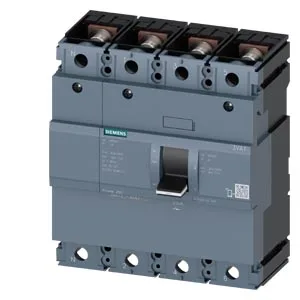
It is designed without overload or short-circuit protection — this is a pure isolating and switching device, not a circuit breaker. The shunt trip (STL) release operates on 220-250 V DC or 208-277 V AC, giving a remote trip capability for emergency-off or interlock circuits.
The 250 A continuous rating (Iu) sets the maximum load current the disconnector can carry without exceeding its thermal limits — sized for a 250 A feeder or the main incoming supply on a distribution panel. Rated insulation voltage Ui of 800 V and max operational voltage of 690 V AC / 600 V DC cover standard 400 V and 480 V industrial networks, with headroom for 690 V applications. The shunt trip (STL) release is the only auxiliary release fitted — no undervoltage release, no auxiliary contacts. If you need remote status feedback or undervoltage protection, those functions must be added externally. The busbar connection on the front terminals accepts standard busbar systems for panel distribution; verify busbar compatibility with the 70 mm depth and 140 mm width before layout.
Switch disconnectors of this class are installed as main isolators in distribution boards, machine control panels, and switchgear assemblies. They provide a visible break for safe isolation during maintenance, and the shunt trip allows remote opening from a safety relay or PLC output. The 250 A frame size suits it as the main disconnect for a group of motor starters, a large machine tool, or a sub-distribution board fed from a transformer.