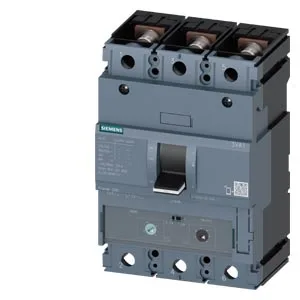
This places it as a main or feeder breaker in a 400 V distribution panel, sized for loads up to that thermal threshold before derating. The 250 A rating holds flat from 40 °C through 50 °C, then steps down to 243 A at 55 °C, 237 A at 60 °C, 230 A at 65 °C, and 223 A at 70 °C — a derating curve that matters when the breaker sits in a warm enclosure alongside other heat sources. Breaking capacity is specified across five voltage levels: 121 kA at 240 V, 75.6 kA at 415 V, 52.5 kA at 440 V, 17 kA at 500 V, and 11.9 kA at 690 V. At 415 V — the common low-voltage distribution voltage in many regions — the 75.6 kA interrupting rating gives substantial fault-current headroom for most industrial service entrances or large sub-distribution boards.
Dimensions are 70 mm depth, 105 mm width, and 158 mm height. The 70 mm depth keeps the breaker within typical distribution board clearance, allowing front-connection cabling without forcing a deeper enclosure.