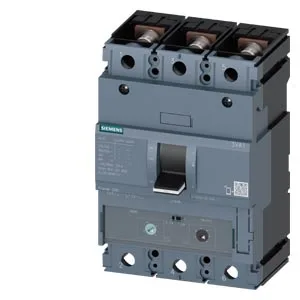
The 250 A rated continuous current (Iu) holds flat from 40 °C through 50 °C (cites:,), then derates to 243.3 A at 55 °C, 236.5 A at 60 °C, 229 A at 65 °C, and 223 A at 70 °C (cites:,). The interrupting ratings are what decide if it clears a fault without upstream gear tripping: 121 kA at 240 V (cite:), 75.6 kA at 415 V (cite:), 25 kA at 440 V (cite:), and 11.9 kA at 690 V (cite:). Those are high — typical for a 250 A frame — so it handles most industrial service-entrance or large-subfeed faults without cascading. The TM240 overcurrent release (cite:) is a thermal-magnetic type — fixed thermal pickup for overloads, magnetic for short-circuits. No electronic adjustability, no communication module (cite:), no phase-failure detection (cite:), and no ground-fault monitoring (cite:). That makes it a straightforward, no-frills feeder breaker for a panel where you don't need metering or remote trip. It comes with two HQ auxiliary switches (cite:) for status feedback. The integrated auxiliary trip accessory is order code 3VA9688-0BL30 (cite:).
The 3VA1225-4EF32-0HC0 is a 3-pole MCCB (cite:) with a 105 mm width, 158 mm height, and 70 mm depth (cites:,). The 15 000 latching-endurance cycles (cite:) is typical for a fixed thermal-magnetic MCCB — it's not a switching device for frequent operations, but it's fine for the occasional open/close during maintenance or fault isolation.