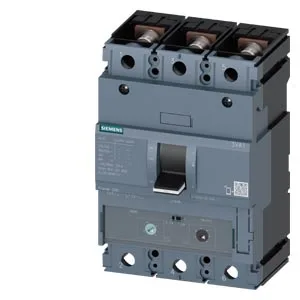
It's the kind of breaker you spec into a panel when you need one device to handle both the load current and a hard fault without welding its contacts shut.
Interrupting capacity — what those voltage columns mean
At 240 V it's rated for 121 kA — enough for a high-capacity transformer secondary. At 415 V it handles 75.6 kA, at 440 V it's 52.5 kA, at 500 V it drops to 17 kA, and at 690 V it's 11.9 kA. Match the voltage you actually run, not the highest number on the nameplate.
Thermal derating — the current it carries when the panel gets hot
Above that it starts to derate: 243 A at 55 °C, 237 A at 60 °C, 230 A at 65 °C, and 223 A at 70 °C.
Shunt trip release — what it adds to the breaker
That means you can trip the breaker remotely by applying a control voltage to the shunt trip coil — useful for emergency-stop circuits, undervoltage protection, or a PLC-driven shutdown. No undervoltage release is fitted from the factory, so if you need UVR you'll add it in the field or order a different variant.
Physical fit — panel and enclosure dimensions
Width 105 mm, height 158 mm, depth 70 mm. Maximum power loss is 57 W.