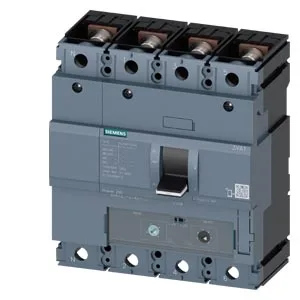
Its 4-pole construction and line-protection profile make it the primary feeder breaker in a distribution panel or a main disconnect for a motor control center. The interrupting ratings climb to 121 kA at 240 V and 75.6 kA at 415 V — figures that govern its placement in high-fault-current locations like transformer secondaries or large busway taps. At 250 A, the breaker holds its full rating from 40 °C up to 50 °C ambient; above that it derates in steps to 223 A at 70 °C. The 3VA1225-4EF42-0AB0 includes two auxiliary switches (HP type) for remote status feedback. If the application needs a remote trip or a ground-fault alarm, this order code is not the one — the auxiliary release slot is empty and the breaker lacks the internal wiring for those options.
It mounts via screw-clamp terminals to a backplate or DIN-rail adapter (not included). Front face carries an IP40 protection rating, suitable for enclosed panel installation where no water jets or dust ingress are expected. The 15000-cycle latching endurance covers the mechanical life; electrical endurance depends on the load type and switching frequency.
The 3VA1225-4EF42-0AB0 is designed to meet IEC 60947-2 and UL 489 standards for molded case circuit breakers. The manufacturer provides RoHS and REACH declarations, along with the device manual covering DC-network application notes (referenced in the spec as a separate document).