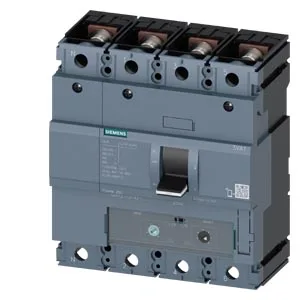
The Siemens 3VA1225-4GF42-0DC0 is a 4-pole SENTRON molded case circuit breaker rated for 250 A continuous current (Iu) at 40 °C ambient — that's the full-load current it carries without tripping in a 40 °C panel environment. At 55 °C it derates to 243.3 A, at 70 °C to 223 A, so if your enclosure runs hot, you need to account for that thermal curve. Breaking capacity is the headline: 121 kA at 240 V, 75.6 kA at 415 V, 25 kA at 440 V, and 11.9 kA at 690 V. The TM240 overcurrent release is a thermal-magnetic type, so it handles overloads (thermal) and short circuits (magnetic) in one package. This is a line protection variant, not a motor protection or generator breaker — it's designed for feeder and distribution circuits. No communication module, no voltage trigger, no phase failure detection — this is a straightforward thermal-magnetic breaker with basic aux contacts and UVR for safety circuits.
If you're evaluating the 3VA1112-5EF32-0CA0 as a potential second source or replacement, the key difference is current rating and frame size. The 3VA1225-4GF42-0DC0 is a 250 A frame; the 3VA1112 is a smaller 125 A frame. Both are 4-pole SENTRON line protection breakers with TM releases, but the 3VA1225 carries significantly higher interrupting capacity at the same voltage points. Panel cutouts and busbar spacing differ between the frame sizes — you can't drop a 250 A frame into a 125 A panel without reworking the bus connections and verifying the thermal rise. For a direct swap without rewiring, stick to the same frame size.
The 70 mm depth leaves room for rear-access busbars or cable ducts behind the breaker. Wire the line side through the top terminals; load side exits the bottom. The undervoltage release coil draws from the control voltage — verify polarity if using DC control, and ensure the UVR supply is fused separately per Siemens guidelines. No communication module means no Modbus or PROFIBUS link — this is a standalone breaker.