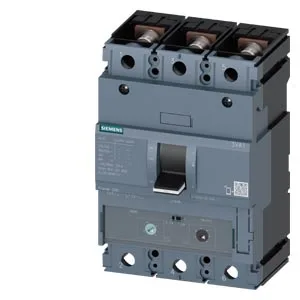
Its 250 A rated continuous current (Iu) holds flat from 40 °C to 50 °C, then derates to 223 A at 70 °C — so the thermal curve stays full-rated in a ventilated enclosure but needs headroom if the panel runs hot. Breaking capacity is the headline: 187 kA at 240 V, 121 kA at 415 V, 36 kA at 440 V, and 17 kA at 690 V. At 415 V — common for industrial three-phase — 121 kA means this breaker can interrupt a fault current that high without upstream fuses or a current-limiting reactor. That is the spec that decides whether it coordinates with the transformer or main breaker in a selective coordination study. Latching endurance is rated at 15 000 operations, which is typical for a panel main or feeder breaker that sees infrequent switching.
Dimensions: 105 mm wide, 158 mm high, 70 mm deep. Depth of 70 mm leaves clearance for rear-mounted busbars or a gland plate behind the DIN rail. Front protection is IP40, so it is suited for enclosed distribution boards but not washdown zones.