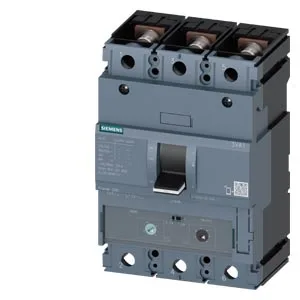
Its 250 A rated continuous current (Iu) holds flat from 40 °C to 50 °C, then derates to 223 A at 70 °C; that thermal curve matters if your enclosure runs hot. The TM240 thermal-magnetic release handles the time-current coordination — thermal for overload, magnetic for short-circuit — and the shunt trip (STL) auxiliary release lets a remote signal or emergency-stop circuit trip the breaker independently of the overcurrent condition. Breaking capacity is the headline number for this class: 187 kA at 240 V, 121 kA at 415 V, 36 kA at 440 V, and 17 kA at 690 V. The 3-pole design covers three-phase systems. Two built-in auxiliary switches (HQ type) give you status feedback — open/closed indication for a PLC or panel lamp — without adding an external contact block.
Footprint: 105 mm wide, 158 mm high, 70 mm deep. That 105 mm width (roughly 4.1 inches) is standard for a 250 A frame MCCB — it occupies three 35 mm DIN-rail modules plus some overhang for the case. The derating above 55 °C is already baked into the current table — no extra calculation needed if your ambient stays under 70 °C.
What's included and what's not
The breaker ships with the TM240 overcurrent release and the shunt trip STL installed. The integrated auxiliary trip order code is 3VA9688-0BL33 — that's the specific shunt trip module inside this variant. Two HQ auxiliary switches are factory-fitted. No undervoltage release, no communication module, no phase-failure detection, no ground-fault monitoring, and no trip indicator. If you need those, you're looking at a different order code in the 3VA family. Latching endurance rated at 15 000 cycles — that's the mechanical life for the switching mechanism under no-load or low-current conditions. Not a wear-out concern for a main breaker that cycles a few times a year, but worth noting if it's used for frequent load switching.