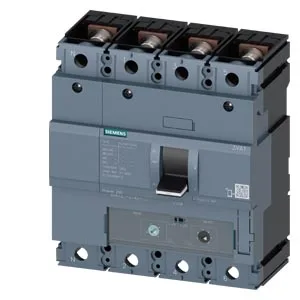
Rated current is 250 A at 40 °C ambient, and it holds that same 250 A all the way up to 50 °C — no derating needed until you cross 55 °C, where it steps down to 243 A, then 237 A at 60 °C, 230 A at 65 °C, and 223 A at 70 °C. That's a solid thermal curve for a warm panel; you don't lose headroom until the enclosure is genuinely hot. Breaking capacity is the number that tells you whether this breaker will hold or blow up on a fault. At 240 V, it's rated to interrupt 187 kA — that's a massive fault current, typical for a main breaker close to a large transformer. At 415 V it's 121 kA, at 440 V it's 75.6 kA, at 500 V it's 30 kA, and at 690 V it's 17 kA. For a 250 A frame, those are high-interrupting ratings; this is not a downstream branch breaker, it's a main or large feeder.
Overcurrent release and auxiliary release
The trip unit is fixed and non-interchangeable. The supplied basic switch is listed as 3VA12255EF420AA0, which is the base breaker without the shunt trip option. So this variant (ending -0KA0) adds the shunt trip, meaning you can trip it remotely from a PLC, E-stop circuit, or fire alarm system — useful for emergency-off or remote disconnect scenarios.
It is a 4-pole MCCB.