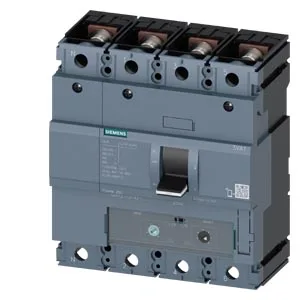
That 250 A holds flat from 40 °C through 50 °C ambient, then derates to 243.3 A at 55 °C, 236.5 A at 60 °C, 229 A at 65 °C, and 223 A at 70 °C — so in a crowded panel running warm, you still have headroom down to 223 A before the thermal element starts to drift. The TM240 overcurrent release is a fixed thermal-magnetic unit, not electronic, meaning no auxiliary power draw and no programming; it trips on thermal overload and instantaneous magnetic short-circuit. The interrupting ratings are the main selection gate: 187 kA at 240 V, 121 kA at 415 V, 36 kA at 440 V, and 17 kA at 690 V.
Built-in auxiliaries and release — one less thing to add
That covers status feedback and remote trip indication without a separate add-on module. The shunt trip release (STL) is also integrated, so you can trigger a remote trip from a safety circuit or E-stop string. The auxiliary trip module is order code 3VA9688-0BL33.
Physical fit — dimensions that matter for panel layout
Width 140 mm, height 158 mm, depth 70 mm. The 140 mm width is the 4-pole frame; a 3-pole sibling in the same 250 A frame is narrower, but this one needs the extra pole space for the switched neutral. Mounting is via the standard 3VA base plate or DIN rail adapter — check the Siemens mounting kit for your enclosure backplate pattern.
If you're looking at the 3VA1110-5EE32-0JA0 as a potential second-source or substitution, the key difference is frame size and current. The 3VA1110 is a 100 A, 3-pole MCCB on a smaller physical frame. The 3VA1225-5FF42-0KH0 is 250 A, 4-pole, and physically larger — it will not drop into a panel cutout or busbar arrangement drilled for the 100 A frame without rework. The interrupting ratings also differ: the 100 A frame typically carries lower SCCR values. If your BOM calls for 250 A feeder protection with a switched neutral, this is the correct frame; the 3VA1110 is for downstream subfeeds or smaller loads.