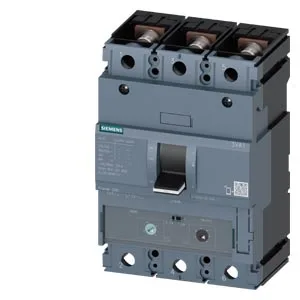
Its 250 A rated continuous current (Iu) holds flat from 40 °C to 50 °C, then derates to 223 A at 70 °C. That thermal curve matters when you're packing breakers into a warm enclosure: no headroom loss until 55 °C, where it drops to 243.3 A, then 236.5 A at 60 °C, 229 A at 65 °C, and 223 A at 70 °C. The interrupting capacity is the headline: 220 kA at 240 V, 154 kA at 415 V, 36 kA at 440 V, and 17 kA at 690 V.
Selectivity and coordination — where the SCCR matters
Below it, you can cascade downstream breakers with lower interrupting ratings, provided the let-through energy stays within their withstand. No phase-failure detection or voltage-trigger function here — this is a straightforward thermal-magnetic protector, not a power monitor.
Dimensions: 105 mm wide, 158 mm high, 70 mm deep. Screw-mount to the backplate or DIN-rail adapter (not included). The IP40 front rating means the breaker's face is protected against solid objects >1 mm, but the rear terminals are not sealed — panel builders should maintain clearance to live parts per IEC 60947-1. The two HQ auxiliary switches occupy the right-side slot; the undervoltage release is factory-installed. No communication module means no bus wiring, but also no remote trip indication beyond the aux contacts.