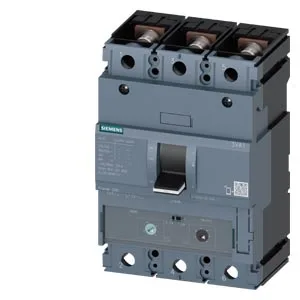
The IP40 front protection keeps dust and small tools out of the breaker face in a clean indoor enclosure.
Current derating and thermal management
Above that, it derates: 243.3 A at 55 °C, 236.5 A at 60 °C, 229 A at 65 °C, and 223 A at 70 °C. That storage range matters if the part sits in a spares crib for a while before installation — it can handle the cold warehouse.
Auxiliary contacts and shunt trip
These are wired into the control circuit for status feedback — the aux contacts signal open/closed, the alarm contact trips on a fault. A shunt trip release (STL) is integrated for remote tripping via a control signal. No undervoltage release or communication module is fitted on this variant. If remote monitoring or a UVR is needed, the order code would differ. The auxiliary trip module carries its own order code 3VA9688-0BL33 — that's the internal accessory, not a separate breaker.
Dimensions: 105 mm wide, 158 mm high, 70 mm deep. The 70 mm depth means it doesn't protrude far into the enclosure, leaving room for wiring ducts or busbars behind it.
Breaking capacity at different voltage levels
The interrupting rating varies significantly with system voltage. At 240 V it's 220 kA; at 415 V it drops to 154 kA; at 440 V it's 36 kA; at 690 V it's 17 kA. The 415 V figure is the one most relevant for a 400 V three-phase industrial panel in Europe or Asia — 154 kA is very high, suitable for a main breaker close to a large transformer. The 440 V and 690 V ratings matter for marine or heavy industrial systems where the line voltage is higher.
Endurance and trip indication
Latching endurance is rated at 15,000 operations. A trip indicator and voltage trigger are built in.