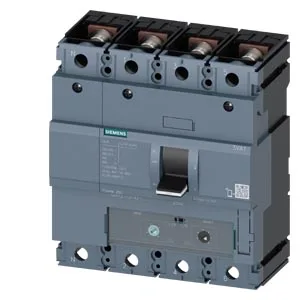
This is the fixed-thermal, fixed-magnetic variant, sized for straightforward feeder or main-switch duty where adjustable trip curves aren't required.
Rated breaking capacity hits 220 kA at 240 V, dropping to 154 kA at 415 V, 36 kA at 440 V, and 17 kA at 690 V. At 415 V — the common industrial distribution voltage — 154 kA gives substantial SCCR headroom for high-fault panels. That level supports full selectivity with downstream 50 kA or 65 kA MCCBs without forcing a series-rated compromise; the upstream breaker clears before the downstream device reaches its limit. The 690 V figure (17 kA) matters for 600 V class installations in North American or marine plants.
Above that, derating begins: 243.3 A at 55 °C, 236.5 A at 60 °C, 229 A at 65 °C, and 223 A at 70 °C. The thermal-magnetic release (TM240) is calibrated at 40 °C; the thermal element tracks ambient, so in a hot panel the breaker trips earlier on overload, which is the intended behavior.
Dimensions: 158 mm height, 140 mm width, 70 mm depth. Four-pole frame, so width is the critical slot dimension — 140 mm matches the standard 4-pole MCCB cutout in most Siemens SENTRON and ALPHA distribution panels.