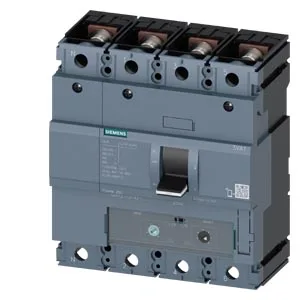
250 A fixed, 4-pole — line protection with shunt trip
Its interrupting capacity reaches 220 kA at 240 V, 154 kA at 415 V, and 17 kA at 690 V — figures that define the available fault current it can safely clear without upstream coordination issues. The TM240 thermal-magnetic release provides overload and short-circuit protection, while the integrated shunt trip (STL) allows remote tripping via a control signal. At 250 A continuous, the breaker carries a maximum power loss of 57 W. The thermal derating curve is published: full 250 A up to 50 °C, then 243 A at 55 °C, 237 A at 60 °C, 230 A at 65 °C, and 223 A at 70 °C. For a panel builder, that means the breaker can be mounted in a standard enclosure without forced cooling at ambient up to 50 °C, but above that, the connected load must be reduced per the curve. The shunt trip release (STL) is factory-installed; no field retrofit required.
Interrupting capacity by voltage — selectivity planning
The interrupting ratings are specified at five voltage levels: 220 kA at 240 V, 154 kA at 415 V, 75.6 kA at 440 V, 30 kA at 500 V, and 17 kA at 690 V. A site electrical engineer sizing for a 415 V distribution board with a 100 kA prospective fault current has 54 kA of headroom — enough to maintain selectivity with downstream breakers without cascading.