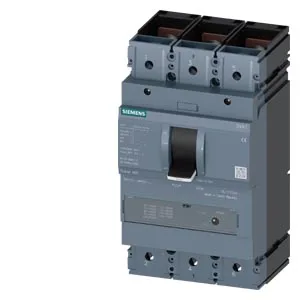
It carries a breaking capacity of 187 kA at 240 V AC, 121 kA at 415 V and 440 V, 75.6 kA at 500 V, and 11.9 kA at 690 V — meaning it can safely interrupt fault currents up to those levels without cascading upstream, which is critical for selectivity coordination in high-fault installations.
The 320 A rating is non-derated up to 50 °C ambient; at 55 °C it carries 313 A, at 60 °C 306 A, at 65 °C 299 A, and at 70 °C 292 A — so in a warm enclosure you lose about 1% per degree above 50 °C, which is typical for this class and worth factoring into your thermal budget. Maximum power loss is 82.6 W — not negligible in a crowded panel; plan for ventilation or derate adjacent devices if you're stacking breakers.
Dimensions are 248 mm high, 138 mm wide, 110 mm deep — standard 3-pole MCCB footprint for a 320 A frame; it mounts on a DIN rail or directly to a backplate, so it drops into most existing SENTRON or third-party panels without re-drilling. No communication module onboard (no Modbus or PROFIBUS), and no ground-fault monitoring — those are separate add-ons if your spec requires them.