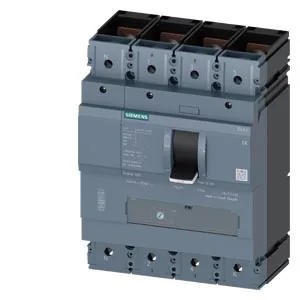
What this 500 A MCCB is and what the ratings mean for fit
The Siemens 3VA1450-7GE42-0AA0 is a 4-pole SENTRON molded case circuit breaker (MCCB) rated at a continuous 500 A, with a TM220 thermal-magnetic overcurrent release designed for line protection — meaning it protects cables and busbars from overload and short-circuit, not motor loads. The interrupting capacity is the headline: 440 kA at 240 V, 242 kA at 415/440 V, 154 kA at 500 V, and 17 kA at 690 V. That 440 kA figure at 240 V tells you this breaker is built for high-fault-current installations — typically large distribution switchboards or transformer secondaries where available fault current is extreme. The 4-pole design (switching all three phases plus neutral) is standard for TN-S or TN-C-S systems where the neutral needs protection or isolation.
Thermal derating and operating limits
Full 500 A rating holds up to 50 °C ambient. Above that it derates: 488 A at 55 °C, 476 A at 60 °C, 464 A at 65 °C, 452 A at 70 °C. If your panel internal ambient runs hot — say a sealed enclosure near a furnace line — that derating curve is the one that governs real-world ampacity, not the nameplate 500 A. Operating temperature range is -25 °C to 70 °C; storage range is -40 °C to 80 °C. The TM220 release is a fixed thermal-magnetic type — no interchangeable trip units, so the 500 A setting is baked in. No undervoltage release, no shunt trip, no ground-fault monitoring on this variant. Power loss at rated load is 122.7 W maximum — plan for that heat in your enclosure thermal budget.
Physical fit and panel integration
Dimensions: 184 mm wide, 248 mm high, 110 mm deep. That 184 mm width on a 4-pole 500 A frame is the critical number for panel layout — it determines the DIN-rail or mounting-plate pitch and whether it fits alongside existing breakers in a multi-column switchboard. IP40 on the front face means it's protected against tools and small wires entering the front, but it's not sealed against dust ingress from the sides or back — standard for enclosed distribution panels. No communication function on this unit; it's a straight electromechanical breaker with no Modbus or PROFIBUS interface.
