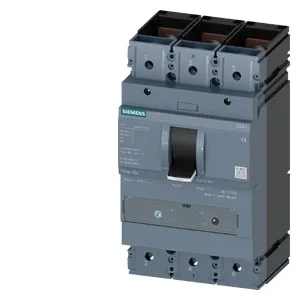
630 A MCCB with undervoltage release — panel integration note
The interrupting capacity reaches 187 kA at 240 V, 121 kA at 415 V, 76 kA at 500 V, and 11.9 kA at 690 V — figures that govern selectivity coordination upstream. Panel footprint is 248 mm high, 138 mm wide, 110 mm deep; the 192.9 W maximum power loss at full load matters for enclosure thermal calculations.
Above 55 °C it derates linearly: 618 A at 55 °C, 607 A at 60 °C, 595 A at 65 °C, and 583 A at 70 °C. For a panel designer, the 630 A frame means this breaker covers main feeder or large motor branch applications where the load current stays under the trip threshold of the TM240 unit.
The interrupting ratings span the common industrial voltage levels. At 240 V the breaker clears 187 kA symmetrical; at 415 V it handles 121 kA; at 500 V it manages 76 kA; at 690 V it interrupts 11.9 kA. These are the values a site electrical engineer uses to verify SCCR compliance per IEC 60947-2 and to coordinate with downstream breakers.
Auxiliary and undervoltage release configuration
The auxiliary contact block provides one normally-open/normally-closed auxiliary switch plus one dedicated trip alarm switch, both rated for the breaker's control voltage. This eliminates the need for a separate shunt trip in most undervoltage protection schemes. The UVR is factory-installed and wired to the breaker's internal terminals.