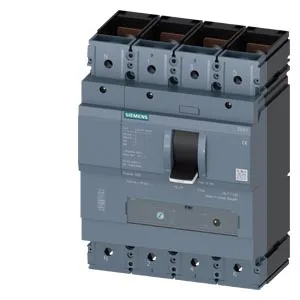
630 A MCCB with TM240 release — line protection for high-fault panels
It is a straightforward, non-electronic MCCB for main feeder or large subfeed applications where selectivity and high interrupting capacity are the priorities. The interrupting ratings are the headline: 440 kA at 240 V, 242 kA at 415 V and 440 V, 154 kA at 500 V, and 17 kA at 690 V. At 630 A frame size, those numbers mean this breaker can be applied on the line side of a high-fault panel without cascading upstream — the SCCR headroom is substantial for 480Y/277 V or 400 V industrial services. Thermal derating is minimal up to 50 °C (full 630 A), then drops to 618 A at 55 °C, 607 A at 60 °C, 595 A at 65 °C, and 583 A at 70 °C. Maximum power loss is 192.9 W.
Dimensions are 248 mm height, 184 mm width, 110 mm depth. The 4-pole frame at 184 mm wide means it occupies roughly 7.24 inches of panel width on the DIN rail or mounting plate.
What the TM240 release means for coordination
The TM240 designation indicates a thermal-magnetic release with a fixed thermal pickup and magnetic trip threshold calibrated for this 630 A frame. Unlike electronic trip units (ETU), the TM240 offers no adjustable long-time, short-time, or ground-fault curves — it is a fixed-characteristic breaker suited for simple line protection where coordination with downstream devices is achieved by selecting the correct frame and rating rather than tuning settings. For applications requiring adjustable protection or ground-fault monitoring, a 3VA1 with an ETU variant would be the alternative.