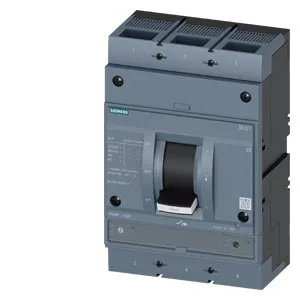
This is a line-protection device, not a motor-protection breaker; it's sized for main feeders or large subfeeders in industrial switchboards.
The 800 A rating holds flat from 40 °C through 50 °C, then derates to 780 A at 55 °C, 761 A at 60 °C, 741 A at 65 °C, and 722 A at 70 °C (–). If your panel ambient hits 55 °C, you lose 20 A of headroom — factor that into the load calculation. The breaking capacity drops as voltage rises: 187 kA at 240 V, 121 kA at 415/440 V, 75.6 kA at 500 V, and 52.5 kA at 690 V (–). The 242.5 W maximum power loss matters for enclosure heat rise — a sealed panel needs that dissipation accounted for in the thermal budget.
The auxiliary switches give status feedback (open/closed) to a PLC or SCADA; the trip alarm signals a fault trip separately from a manual open.
Lifecycle status is current — this is an active-production part in the SENTRON 3VA family. No phase-out or last-time-buy notice.
Dimensions: 320 mm height, 210 mm width, 120 mm depth. That's a 3-pole frame that mounts in a standard switchboard cubicle — not a DIN-rail device. The 210 mm width means it occupies roughly 8.3 inches of panel width per pole. The 120 mm depth (4.72 in) leaves clearance behind the door for wiring and the auxiliary switch block. The trip indicator gives a visual flag on the breaker face after a fault — saves opening the door to check.