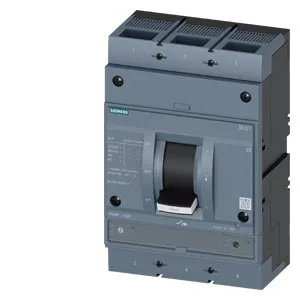
What this 3VA1 breaker carries
The Siemens 3VA1580-6GF42-0DB0 is a 4-pole IEC frame 1000 circuit breaker in the 3VA1 series, rated 800 A continuous with a breaking capacity class H — Icu of 70 kA at 415 V. That puts it in the high-interrupting tier for industrial distribution: it clears a 70 kA fault without external fusing, which simplifies panel coordination and keeps SCCR headroom for downstream gear. The TM240 thermal-magnetic trip unit gives an overload protection range Ir = 560…800 A and short-circuit pickup Ii = 5…10 × In. That adjustable band lets you tune the breaker to the actual load cable without swapping trip units — useful when the same panel frame serves multiple feeder sizes. The UVR automatically opens the breaker on loss of control voltage — standard for emergency-stop chains or undervoltage protection schemes where you want the load to drop if the control supply fails.
The lifecycle stage for this order code is listed as current, meaning Siemens still manufactures it as a standard catalog item. No last-time-buy or phase-out notice applies to this specific variant.
In a typical 400 V industrial panel with a transformer rating above 1 MVA, fault levels can hit 50-65 kA — this breaker gives you margin above that. The 100% N-conductor protection means the neutral pole is rated for full phase current, not a reduced cross-section, which matters for harmonic-rich loads or shared-neutral feeders. The TM240 trip unit is a fixed thermal-magnetic design, not an electronic one. That means no auxiliary power needed for the trip function, but also no adjustable time-current curves beyond the Ir and Ii dials. For applications needing selective coordination with downstream breakers, the magnetic pickup range (5-10× In) gives some flexibility to avoid nuisance trips on motor inrush.