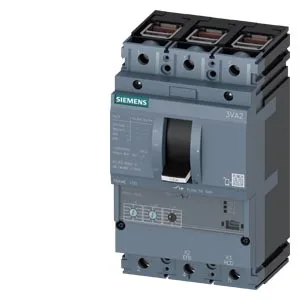
Its adjustable thermal-magnetic trip unit covers 150 A to 1200 A, so one frame size handles a wide range of downstream loads; set the trip to match your feeder or branch circuit, not the other way around. Breaking capacity is the headline selector: 187 kA at 240 V AC, 121 kA at 415/440 V, 75.6 kA at 500 V, and 3 kA at 690 V. The 690 V figure (3 kA) is low; if your system runs 690 V and fault current exceeds that, you need a higher-rated frame or a current-limiting upstream device. Power loss is 13.5 W maximum — negligible for thermal rise in a standard enclosure, but worth noting if you are packing multiple breakers into a sealed, non-ventilated cabinet.
If you are comparing against the 3VA2116-5JP32-0AE0 (a higher-frame 160 A MCCB), note that the 3VA2010 is physically smaller — 105 mm wide vs the 3VA2116's wider footprint — so a direct swap without rewiring or re-drilling the mounting plate is not guaranteed. Always verify the mounting hole pattern and bus-bar spacing before committing.
The breaker ships without a trip indicator, undervoltage release, communication module, or ground-fault monitoring — it is a bare line-protection device. If you need auxiliary contacts, the order code includes three auxiliary switches (HQ type). Verify that the auxiliary switch wiring matches your control voltage and that the switch rating covers your PLC input load.