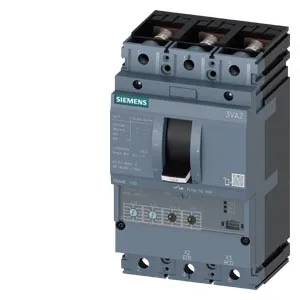
It carries a continuous current Iu of 100 A across the full operating temperature range from -25 °C to 70 °C, with zero derating from 40 °C through 70 °C — that's flat 100 A all the way, which simplifies panel thermal calculations.
Breaking capacity — the real fault-handling story
At 240 V it clears 187 kA — that's high enough for most main-service positions on 208/240 V distribution. At 500 V it drops to 75.6 kA, and at 690 V it's 3 kA — that 690 V figure tells you this is not a 690 V main breaker; it's a feeder breaker on lower-voltage sections where fault current is limited.
Auxiliary contacts and undervoltage release — what's on board
That's enough for a status feedback to a PLC (breaker open/closed and tripped) plus a spare auxiliary for a shunt trip or indicator light. The undervoltage release (UVR) is included — it's the design, which means the breaker drops open when control voltage falls below a threshold, useful for safety circuits that need a loss-of-voltage trip.
Width is 105 mm (4.13 in), depth is 86 mm (3.39 in), height is 181 mm (7.13 in). The breaker mounts via the rear screw terminals or plug-in base (not included), typical for panelboard or switchboard integration.