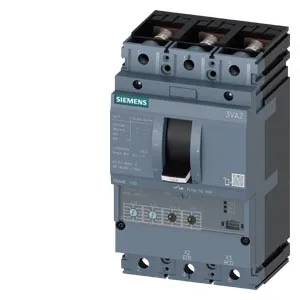
Siemens 3VA2010-5HN32-0KA0 — 100 A MCCB with ETU350, Current Production
Breaking capacity is the headline spec here: 187 kA at 240 V, 121 kA at 415 V and 440 V, 79 kA at 500 V, and 3.4 kA at 690 V. That 187 kA at 240 V means it can safely interrupt fault currents up to that level without cascading upstream — critical for high-fault panels near large transformers or service entrances. The steep drop to 3.4 kA at 690 V reflects the physics of arc extinction at higher voltages; if your system runs 690 V, verify the available fault current stays under that limit. Thermal derating is published per degree: full 100 A up to 50 °C, then 96.25 A at 55 °C, 92.5 A at 60 °C, 88.75 A at 65 °C, and 85 A at 70 °C. If the breaker lives in a warm enclosure — say adjacent to a drive or transformer — size the load current against the 55 °C or 60 °C column, not the 40 °C rating.
Panel Fit and Mounting
Dimensions are 105 mm wide, 181 mm tall, and 86 mm deep. That 86 mm depth is the body only — add clearance for the shunt trip wiring and any finger-safe terminal covers. The 105 mm width is standard for a 3-pole 100 A frame in the 3VA2 series; it occupies three 35 mm DIN-rail modules worth of panel space if using an adapter base, or it bolts directly to a mounting plate via the four corner slots.
Trip Unit and Auxiliaries
The ETU350 overcurrent release is a microprocessor-based unit with adjustable thermal and magnetic settings — typical for feeder or main breaker duty where coordination with downstream breakers matters. This variant ships with a shunt trip (STL) release, part number 3VA9688-0BL33, integrated from the factory. No undervoltage release, no auxiliary contacts, no ground-fault monitoring on this configuration. Power dissipation is 13.5 W maximum; factor that into the enclosure thermal calculation. Rated insulation voltage Ui is 800 V, which covers 480/600 V systems with margin. Operating temperature range is -25 °C to 70 °C; storage range is -40 °C to 80 °C. The 20 000-cycle mechanical endurance is typical for a 100 A frame — fine for infrequent switching (main breaker duty), not for daily motor starting.
