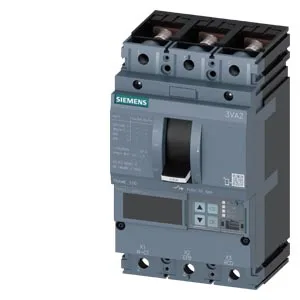
It's a 3-pole unit rated 100 A continuous at 40 °C, sitting in a 150–1200 A frame — meaning the same physical breaker can be ordered with different trip units to cover that whole range, but this specific variant is set for 100 A.
Interrupting rating is the headline spec on any MCCB, and this one delivers 187 kA at 240 V, 121 kA at 415 V and 440 V, 75.6 kA at 500 V, and 3 kA at 690 V. That steep drop at 690 V is typical for a 100 A frame — the arc energy at higher voltage limits what a compact interrupter can clear. For most North American 480Y/277 V or European 400 V panels, the 121 kA figure gives plenty of headroom for high-fault installations like industrial substations or large motor control centers. The 3 kA at 690 V means it's not your first choice for 690 V mining or marine switchgear unless the available fault current is known to be low.
Thermal performance and ambient derating
Built-in extras: undervoltage release and communication
This variant includes an undervoltage release (UVR). It also has a communication function. No ground-fault monitoring on this version.
The 105 mm width matches the typical 4.13-inch slot in a switchboard or MCC bucket. Depth of 86 mm (3.39 in) is shallow enough for most deadfront enclosures without hitting the door.