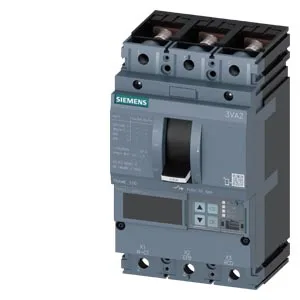
It's a current-production part (lifecycle stage: current) from the 3VA platform, meaning it's the active design you'd spec into a new panel or pull as a like-for-like replacement on an existing SENTRON line.
This MCCB delivers 187 kA interrupting capacity at 240 V, 121 kA at 415 V and 440 V, 79 kA at 500 V, and 3.4 kA at 690 V. For most 400 V-class industrial panels, the 121 kA rating gives solid selectivity headroom against upstream 1600 A or 2000 A frames.
Above that, it derates: 96.25 A at 55 °C, 92.5 A at 60 °C, 88.75 A at 65 °C, and 85 A at 70 °C.
It also includes an undervoltage release (UVR) — the design of the auxiliary release is listed as undervoltage release. That UVR is useful for safety circuits where a loss of control voltage should drop the breaker open, or for remote shunt-trip applications. The HQ auxiliary contact block gives you enough dry contacts for a PLC status input, a remote SCADA alarm, and a local panel light, with one spare.
Communication capability
A communication function is present on this unit. The 3VA platform supports plug-in communication modules (PROFIBUS, PROFINET, Modbus TCP) via the 3VA9 accessory range. If you need to pull trip data, energy metering, or breaker status into a control system, this frame accepts those modules. The base breaker without a module installed still communicates via the mechanical flag and auxiliary contacts, but the electronic trip's data port is ready for a module.
The 105 mm width is standard for a 3-pole 100 A frame in the 3VA series — it fits the same mounting footprint as other 3VA1 3-pole units. The 86 mm depth includes the handle and arc-chamber protrusion; check clearance to the enclosure door if you're mounting it in a shallow wall-mount box. Panel cutout and mounting pattern match the 3VA1 family, so a swap from an older 3VA1 or 3VL frame may need a new escutcheon or adapter plate.