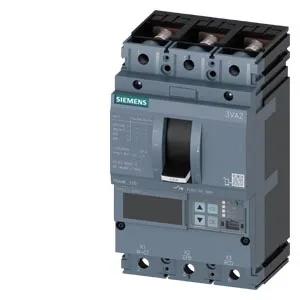
Rated continuous current Iu is 100 A, and it carries a breaking capacity of 187 kA at 240 V, 121 kA at 415 V and 440 V, 79 kA at 500 V, and 3.4 kA at 690 V. The 3-pole frame uses an ETU560 electronic overcurrent release. An undervoltage release (UVR) is integrated. Ground fault monitoring is implemented via summation current formation on the L-conductor. The unit includes a communication function for integration into higher-level control or monitoring systems. The 100 A rating is sustained without derating up to 50 °C ambient. Above that, the continuous current must be reduced: 96.25 A at 55 °C, 92.5 A at 60 °C, 88.75 A at 65 °C, and 85 A at 70 °C. This derating curve is critical for panel layout in warm environments — a panel builder should calculate the expected internal ambient before sizing the branch circuit.
Mounting dimensions and panel integration
The 3VA2010-5JQ32-0DA0 occupies a 3-pole footprint: width 105 mm, height 181 mm, depth 86 mm. These dimensions govern the DIN-rail or screw-mount spacing inside the enclosure. No auxiliary contact is pre-installed (code indicates without), but the design accepts add-on auxiliary switches if needed later.
The ETU560 release provides adjustable long-time, short-time, instantaneous, and ground-fault protection curves. The ground fault monitoring method (summation current on L-conductor) detects leakage current without a dedicated neutral CT, simplifying wiring in 3-wire systems.